
 Chat with us on WhatsApp
Planning the full relocation? Start with our Moving to Alaska guide to communities, housing and arrival planning, then use this article for the next decision.
01
Why vacancy belongs in the investment worksheet
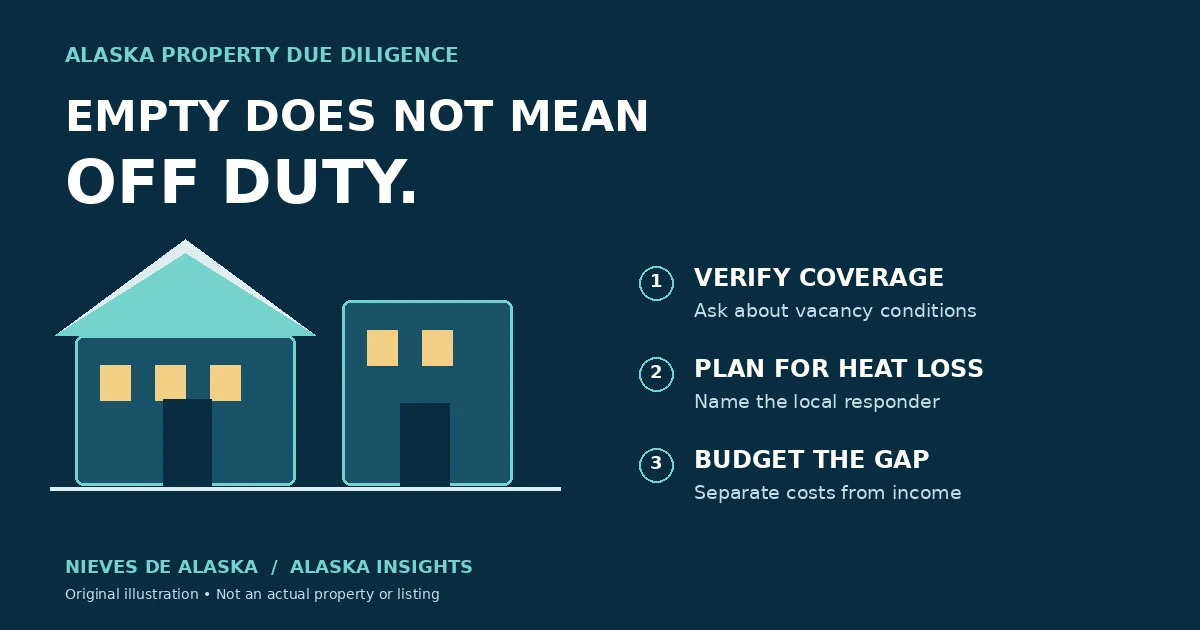
Vacancy removes rental income; it does not necessarily remove the need for heating, inspections or emergency access. Treat those responsibilities as a separate part of acquisition due diligence, not as a footnote to advertised rent.
There is a timely Alaska cost signal, with important limits. DCRA’s Summer 2026 fuel survey, collected July 15–August 24, reports an average heating-fuel price of $7.97 per gallon across 90 surveyed, unsubsidized reporting communities. That is not a statewide household price: the survey excludes Anchorage and Mat-Su, and subsidized North Slope communities are excluded from this heating-fuel average. It is a point-in-time survey, not a November quote or a winter forecast.
For a particular property, obtain current supplier information and a documented operating plan. Do not multiply the survey average by an assumed consumption figure and call it that building’s budget. Our utility-cost guide covers bills and lease allocation; this checklist addresses the different problem of protecting a building while it is empty.
02
Before closing, ask for the winter handoff
UAF Cooperative Extension’s cold-weather guidance distinguishes a heated house from a house intentionally left unoccupied and unheated. The latter requires attention to water lines, tanks, the water heater and plumbing traps. Electric heat tracing loses its freeze-protection function when power is off. Backup heat may not warm every space served by the normal system.
Use those distinctions to ask better questions. The following is an editorial due-diligence checklist, not a substitute for an inspection or a universal winterization procedure:
- Current condition: Is the building heated, professionally winterized, or neither? Request dated work records, known freeze-loss and repair information, and an appropriate inspection. The word “winterized” alone does not establish condition.
- Responsibility at transfer: Who keeps utilities active before and after possession? Who orders fuel, checks the building and pays for emergency service? Resolve any gap in writing with the relevant professionals.
- Vulnerable areas: Ask a qualified contractor to assess plumbing near exterior walls, crawlspaces and other areas not represented by the main thermostat reading.
- Response: Identify a reachable local person with access, a backup contact and a plan for loss of heat or power. Confirm access and snow-removal arrangements rather than assuming someone can reach the building.
- Reopening: If systems have been shut down, obtain a property-specific recommissioning plan before occupancy. Do not assume that turning equipment back on is the only step.
A remote alert can help reveal trouble, but it does not repair a furnace or reach a property. Check its power and connectivity dependencies and who will act on the alert. Keep a record of checks and service work.
03
Ask about coverage before the building becomes empty
The National Association of Insurance Commissioners’ February 8, 2024 guidance explains that burst-pipe water damage is often covered under homeowners policies, but reasonable freeze-prevention measures matter. Coverage is not automatic, and that consumer guidance does not establish what a commercial policy covers.
Ask the insurer or licensed insurance professional to confirm, for the specific property and policy:
- How does the policy define vacant versus unoccupied, and when must you notify the insurer?
- What heat, inspection or water-system precautions are required?
- Do renovation, tenant turnover or a change in use affect coverage?
- Which exclusions, deductibles and endorsements apply to freeze-related damage?
Obtain the answer in writing and retain the policy wording. There is no universal vacancy-day limit or thermostat setting in this article. A smart sensor, a seller’s assurance or a generic checklist is not a coverage guarantee. The Alaska Division of Insurance’s disaster-preparedness resources provide a free starting point for consumer guidance.
04
Small commercial and mixed-use buildings need an extra layer
The Insurance Institute for Business & Home Safety’s Winter Ready business checklist calls for testing freeze alarms, inspecting vulnerable pipes and openings, arranging HVAC service, and reviewing fire-sprinkler exposure with a licensed fire-protection specialist. It also recommends knowing roof snow-load capacity and consulting a structural engineer when that capacity is unknown.
Domestic-water winterization is not permission to disable fire protection. Have the appropriate specialists resolve sprinkler, heating and life-safety requirements together. A storefront, warehouse and apartment above a shop can have different systems and responsibilities even within one building.
Review the lease and management agreement with qualified advisers to identify responsibility for vacant areas, common spaces, snow and ice, emergency access and restoration after a loss. Budget documented holding costs separately from projected rent. These are planning questions, not a claim about a particular lease’s enforceability, available insurance or likely investment return.
05
Frequently asked questions
Can I turn the heat off between tenants?
Do not treat vacancy as permission to turn it off. First obtain a qualified contractor’s property-specific plan and confirmation of the insurer’s requirements. A building with water-filled systems may need protection beyond a single shutoff valve.
Does a normal thermostat reading mean every pipe is safe?
No. Other spaces may be colder. Ask about the actual pipe locations and how those areas are protected, including during a power outage.
Does “winterized” mean the property has no damage?
No. Verify what work was performed, when, and by whom; review condition and repair records and obtain appropriate inspections. Winterization and proof of existing condition are different questions.
Are the fuel figures current November prices?
No. They describe DCRA’s July–August 2026 survey collection period. Source checking on November 12 does not change the observation period or replace a current local quote.
How can Nieves de Alaska help?
Use our free Alaska Resource Hub to organize your research, or request a local professional match. Nieves de Alaska LLC is a referral and relocation-matching service, not your property manager, insurer or brokerage representative. Consumers pay no matching fee to Nieves de Alaska; separate professional and transaction fees may apply.
Use consistent, lawful criteria when evaluating properties and applicants. Do not steer or screen on protected characteristics. No coverage outcome, rent, appreciation or investment return is guaranteed.
Published and source-checked November 12, 2026. Fuel observations: July 15–August 24, 2026. Other sources are standing safety and insurance guidance, not current weather forecasts. General education, not personalized investment advice.
ABOUT THIS GUIDE
Local context, clearly bounded.
Prepared by the Nieves de Alaska Editorial Team. Nieves de Alaska LLC is a veteran-owned Alaska real estate referral service and is independent of the government agencies linked here. This guide is general education—not legal, tax, engineering, environmental, lending, insurance, military, inspection, or brokerage advice. Requirements vary by property, location, lender, insurer, agency, and transaction. Verify current requirements with the linked official source and appropriately licensed professionals before acting.
SOURCES
Primary resources used for this guide
- Alaska DCRA — Summer 2026 fuel survey; collection July 15–August 24, 2026
- UAF Cooperative Extension — Keeping Your House Operating During a Cold Alaska Winter (EEM-04955)
- NAIC — Burst-pipe homeowners coverage guidance, February 8, 2024
- IBHS — Winter Ready business checklist (2023)
- Alaska Division of Insurance — Disaster Response and Preparedness
Source check completed November 12, 2026. Recheck time-sensitive rules, fees, schedules, forms, and requirements before action.