
 Chat with us on WhatsApp
01
What do the 2026 rent figures actually measure?
The state’s March 2026 rental information distinguishes the monthly payment to the landlord from a utility-adjusted measure. Adjusted rent adds an allowance for utilities not included in the contract. It is not evidence that a landlord receives the adjusted amount.
For two-bedroom apartments in March 2026, the official survey table reports Anchorage median contract rent of $1,525 and median adjusted rent of $1,720, across 3,545 surveyed units. Fairbanks North Star Borough reports $1,575 and $1,710, respectively, across 1,102 units. These are medians for surveyed units—not quotes for an available apartment or estimates of any particular building’s expenses.
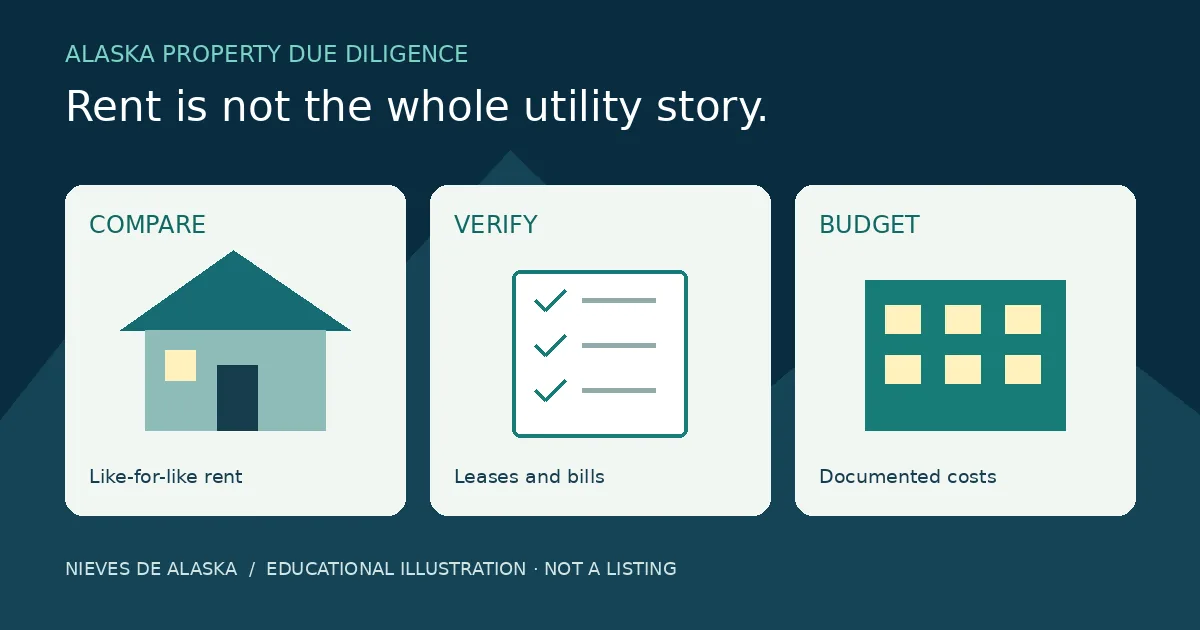
Our interpretation: a rent comparison without the utility arrangement can be misleading. Do not subtract those two medians and call the result the actual utility bill for a property. Match the location, unit type and service responsibilities before judging a comparable rental.
The survey methodology warns that sample sizes vary and the mix of unit types may differ from the wider market. It covers market-rate residential rentals in selected areas, not every Alaska property. Nightly rentals and nonresidential units are excluded. Its apartment category includes duplexes, triplexes, fourplexes and other non-single-family units.
02
What should you request before comparing rental properties?
Build a utility-responsibility sheet for each candidate. This is our practical due-diligence checklist, not a statement that every seller has complete records:
- Lease evidence: current signed leases and amendments showing which services are included, separately billed or reimbursed. Ask a qualified adviser to explain unclear clauses.
- Billing evidence: at least a full year of available utility statements, with service dates, usage and charges. Note missing months rather than substituting a convenient average.
- Metering: which meters serve each unit, shared space or another building? Ask the relevant provider or qualified contractor to verify arrangements.
- System records: heating-system age, inspection and service history, fuel storage or delivery arrangements, and known repair estimates.
- Other recurring costs: water, wastewater, garbage, snow removal and management responsibilities. Keep these separate from financing and major replacements.
Compare documents with the physical inspection. A rent roll marked “utilities included” is not enough to establish which services, spaces or periods it covers.
03
How do you turn bills into a winter planning budget?
Keep historical usage, current quoted prices and your assumptions in separate columns. Ask whether the history reflects full occupancy, a vacant unit, unusual repairs or a different heating arrangement. A low bill during one period does not prove an efficient building.
Prepare a base case from documented expenses and a clearly labeled downside case for higher costs, delayed occupancy or a repair. Do not use a statewide rent statistic as a reserve recommendation. Have appropriately qualified local professionals review equipment condition and estimates before relying on them.
Where tenants pay utilities directly, those payments are not landlord income. Where the owner pays, include the verified expense in operating costs rather than treating gross rent as spendable cash. This utility worksheet complements our broader cash-flow guide; it does not refresh that article’s earlier financing data.
04
What carries over to commercial or mixed-use property?
The document-checking process carries over; the residential survey numbers do not. Because the survey excludes nonresidential units, it cannot establish office, retail or industrial rents, vacancy or operating expenses.
For mixed-use buildings, separate residential and commercial income and expense schedules. Ask a commercial real-estate professional and qualified legal adviser to review each lease’s utility, maintenance, common-area and reimbursement terms. Verify shared meters and allocation methods rather than assuming every tenant pays the same way. These are due-diligence questions, not a claim that a particular lease structure or cost recovery is available or enforceable.
05
Frequently asked questions
Is this October 2026 rental-market data?
No. We checked the official sources on October 29, but the figures describe March 2026. Obtain current local comparable evidence before making a decision.
Does “utilities included” make a property a better investment?
Not by itself. Compare the actual rent collected, owner-paid costs, condition and lease obligations. Neither arrangement guarantees positive cash flow.
Can I apply the apartment figures to a nightly rental?
No. The survey excludes nightly rentals. That business model needs its own operating evidence and review of applicable local rules.
Where can I organize the next step?
Start with the free Alaska Resource Hub, then request a local professional match. Nieves de Alaska LLC provides referral and relocation matching—not brokerage representation, property management or personalized investment advice. Consumers pay no matching fee to Nieves de Alaska; separate professional and transaction fees may apply.
Evaluate properties and apply consistent lawful practices without steering or screening based on protected characteristics. No rent, appreciation, return or transaction result is guaranteed.
Published and source-checked October 29, 2026. Survey observation period: March 2026. Educational planning guidance, not a property recommendation.
ABOUT THIS GUIDE
Local context, clearly bounded.
Prepared by the Nieves de Alaska Editorial Team. Nieves de Alaska LLC is a veteran-owned Alaska real estate referral service and is independent of the government agencies linked here. This guide is general education—not legal, tax, engineering, environmental, lending, insurance, military, inspection, or brokerage advice. Requirements vary by property, location, lender, insurer, agency, and transaction. Verify current requirements with the linked official source and appropriately licensed professionals before acting.
SOURCES
Primary resources used for this guide
- Alaska Department of Labor and AHFC — March 2026 rental information and adjusted-rent definition
- Alaska rental market survey results — 2026, by area, unit type and bedrooms
- Alaska Department of Labor — survey coverage, definitions and limitations
Source check completed October 29, 2026. Recheck time-sensitive rules, fees, schedules, forms, and requirements before action.